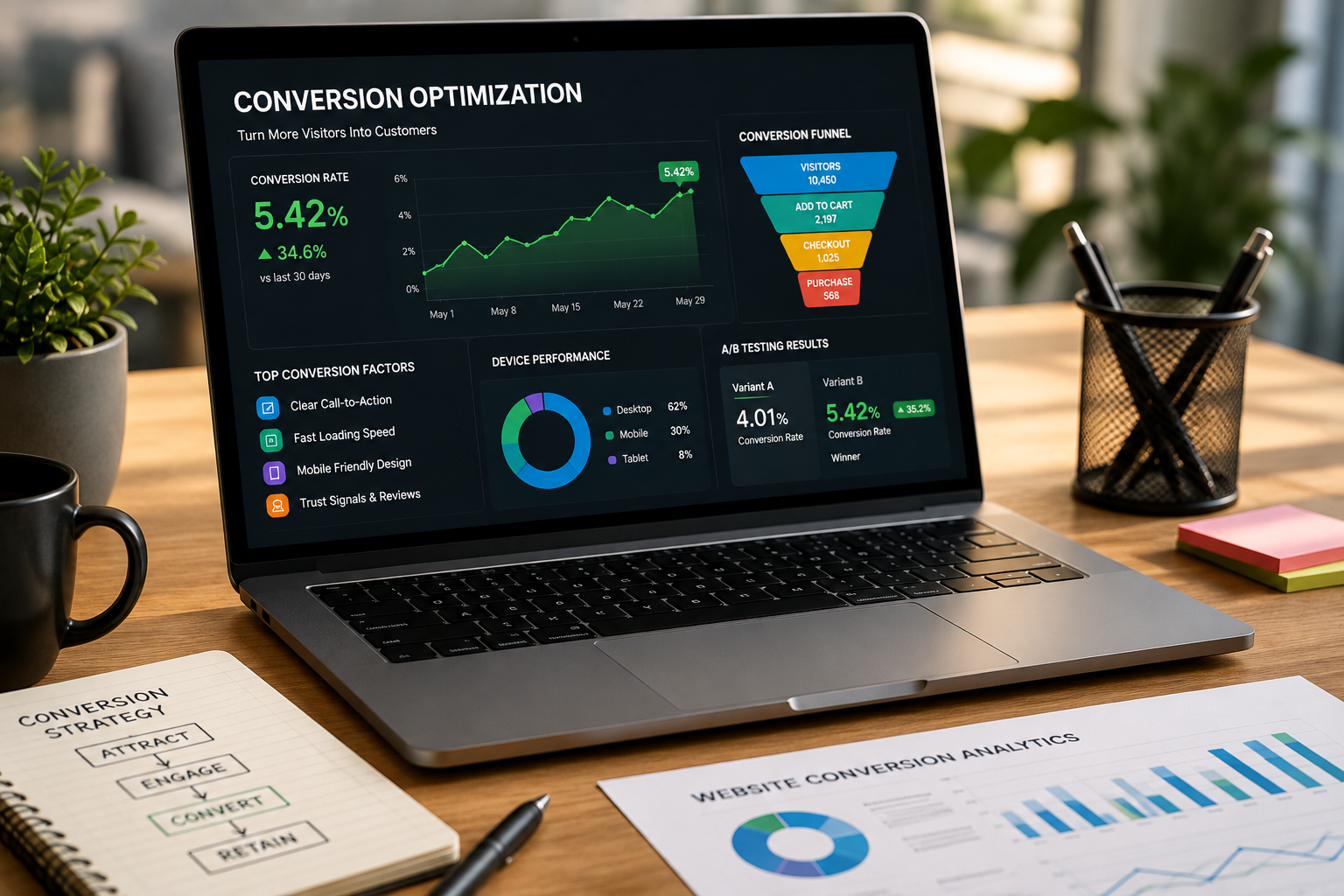
If visitors aren’t taking steps for the website to take any action, then the website can get thousands of visits and still have disappointing results. Web traffic is just a single component of digital marketing. Businesses also want to prompt visitors to buy products, fill out forms, request information, sign up for newsletters, book appointments, or take some other desired action. Now conversion optimization comes into play.
Conversion optimization involves making adjustments to a website or digital experience to increase the rate of conversion. Businesses can do more than just try to attract more visitors to their websites; they can enhance the experience for the visitors who are already on it. If it is done correctly, conversion optimization can help generate more leads, sales, engagement, and maximize your marketing ROI.
What is Conversion Optimization?
Conversion optimization is about understanding what is happening on a website’s landing pages and how users are interacting with them, and then refining them accordingly so that users are engaged to take action. Depending on the purpose of a website, a conversion may be anything beneficial that you can do.
A conversion can be a successful sale for an e-commerce business. For a service company, it could be a contact form submission or consultation request. It could be an email subscription or account sign-up for a content site.
The aim isn’t to make random changes to web pages. Conversion optimization is all about data, behavior, testing, and improvement.
Why Does Website Optimization for Conversion Improve the Number of Conversions?
One way to improve conversions is to eliminate any barriers or obstacles that prevent visitors from taking an action. If a page is slow to load, the site navigation is confusing, or if there is a call-to-action that is not obvious, or too many steps in the checkout process, a visitor can leave a site.
Addressing these challenges and enhancing the user experience can lead to a smoother transition between interest and action for visitors to a business.
Sometimes, making a registration form simpler can make it less difficult. Making product descriptions better can help your customer make a buying decision. If there’s a call to action, make it more visible to guide your visitors to the next step.
It can make a difference when made to high-traffic pages.
But Why is UX Important for Conversion Optimization?
The user experiences of visitors to a website have a significant impact on whether or not they stay on the site and take an action. Visitors are likely to abandon a website if it is complicated to use before they get to the conversion.
The user experience should include an easy-to-use navigation system, easy-to-read content, logical page flow, fast load, and ease of interaction. When a visitor arrives at a website, they should be able to see what type of business the site is associated with and what they should do next.
The usability of mobile devices is also important, as many people use a mobile device to navigate the website. Mobile-optimized forms, readable text, easy-to-use buttons, and responsive layouts may help lead to a smoother experience.
What is the Value of Better Calls-to-Action?
CTAs (calls to action) are statements that prompt visitors to take a certain action. These can range from ‘Get Started’, ‘Buy Now’, ‘Request a Quote’, ‘Schedule a Consultation’ or ‘Download the Guide’.
It is important that the CTA conveys exactly what actions to take when users click it. It should also be distinguishable from other content on the page, yet not overwhelm it.
It’s not just about where you place it, though. A CTA can be placed close to relevant data, benefits of the product, pricing or other sections where visitors may be ready to take action.
There are many different options businesses can try, including varying the content, placement and design of the CTA, as well as the content that surrounds it.
How Does Website Speed Affect Conversion Optimization?
The page loading speed is one of the parameters that can directly affect the user experience. Users typically have high standards for website speed. If pages do not load quickly, there is a risk of losing users.
Optimizing images, minimizing superfluous scripts, implementing efficient hosting, reducing unnecessary plugins, and boosting technical performance are all ways businesses can optimize website speed.
Assessments should be made on desktop and mobile devices. A well-rating website can be slow for mobile users if they have a slower connection.
Making things faster can thus enhance user satisfaction and conversion rates.
What Do Landing Pages Do to Improve the Conversion Process?
Landing pages are an essential part of conversion strategies and are designed for a particular purpose. The page designed should be in line with the expectations of the visitor and should offer enough information to prompt him or her to take action.
Good landing pages typically have a compelling headline, short body copy, benefits, trust signals, and a strong CTA.
The content should be directed towards the needs of the visitor and not just the company. Describing a problem that the product or service solves can make the offer more attractive.
When a landing page only has one conversion objective, businesses should also avoid any unnecessary distractions.
What is the benefit of A/B Testing for Conversion Optimisation?
A/B testing is used to determine which version of a page or element works better for a business. For instance, a business could test two headlines, CTA buttons, images, layouts, or form designs.
Rather than making assumptions based on their own interpretation, businesses can analyze changes in visitor behavior as actual data.
A/B testing should be done in a systematic manner. Testing multiple changes simultaneously can make it hard to identify how different things have affected the performance. Businesses need to have a clear objective and gather sufficient data before concluding.
With repeated testing over time, trends may emerge on what is effective and what is not.
How can Trust Signals help Improve Website Conversions?
If a visitor doesn’t trust a website, they may not do anything. This uncertainty can be mitigated and visitors made at ease by the use of “trust signals”.
These include customer reviews, testimonials, case studies, secure payment marks, clear policies, recognizable certifications, and clear contact info.
Product reviews and return policies are effective for ecommerce sites to ease buying anxiety. Testimonials and case studies can show past achievements for service providers.
Trust signals are authentic and relevant. There is a need to avoid misrepresentations in claims, as short-term gains may harm the long-term credibility of a business.
What Benefit can be Gained From Simplifying Forms to Enhance Conversions?
The longer or more complicated the form, the less likely that visitors will fill it out. If the business just needs a name and an email address, then having too many more fields may cause some problems.
Form optimization means looking at all the form fields required. The fewer the fields, the quicker and easier it will be.
Labels, instructions, error feedback, and mobile-friendly layouts can also enhance the form completion process.
But businesses need to have simplicity with useful information. The ideal form gathers the data that is needed for the next step in the business but doesn’t put any barriers in the way.
What are How Analytics Can Help With Conversion Optimization?
Analytics can give you a lot of insight into visitor behavior on your website. There are various metrics that businesses can track, including the conversion rate, bounce rate, traffic sources, engagement rate on pages, form fill rate, and checkout abandonment.
These metrics can be used to find out which pages are successful and which ones are not.
For instance, if a product page is getting a lot of traffic but not many sales, companies can look at the content of the page, how prices are displayed, product images, CTA, reviews, or checkout process.
Using behavior analysis to make decisions about what to improve based on the evidence instead of assumptions.
What are the Common Mistakes That are Made in Conversion Optimisation?
A frequent error is changing without knowing the issue. If the issue is poor product information or a complicated checkout, a new button color or headline may not resolve the problem.
A second error is just concentrating on the conversion rate. An increase in conversion rate isn’t always a good thing if the customers you are converting are not quality customers or not profitable.
For companies, it is essential not to plagiarize their competitors without taking into account their target audience. One company’s solution may not be another company’s solution.
Last but not least, conversion optimization is not a project to be completed one time, but it is a continuous process.
Conclusion
By optimizing conversion, businesses can turn more website visitors into customers, leads, subscribers, or whatever other goals they have. All these factors can eliminate barriers that hinder website visitors from engaging in action: with improvements in user experience, the forms are easy to complete, the call to action is strong, website speed is improved, trust is built, and data-driven testing eliminates trial and error.
The best way is to be persistent and based on evidence. Businesses should detect the issues, create solutions, test them, analyze the outcome, and keep enhancing their website instead of making random changes. By optimizing conversion efforts, businesses can leverage existing traffic to their website and enhance the customer experience, resulting in greater growth opportunities.